Using information processing tools to encourage historical thinking
Information processing tools (word processors, presentation software etc.) can powerful tools for students to develop and show their understanding. Teachers should bear the following overarching principals in mind when making choices about which information processing apps to use in their classes:
The app should support the learning intentions and be integrated into the learning design
Consideration should be given to how well students know how to use the app and whether they will spend more time and energy learning how to use the app, or to show their understanding
Some apps can helpfully facilitate student collaboration (like Google Docs), but they can also facilitate short-cuts (division of work; copy/paste etc.)—teachers should consider the extent to which the product that students produce is a fair reflection of their historical understanding
Different apps open up the opportunity for differentiation—particularly in differentiating the product and process of student learning
The suggested activities are just some examples of how information processing apps can be used to support the development of students’ historical thinking skills.
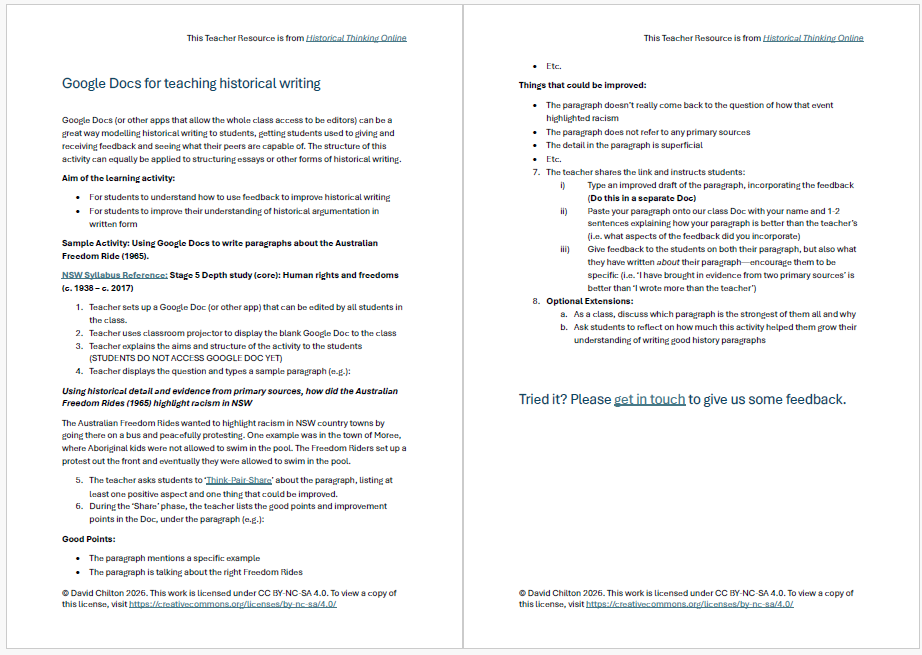
Google Docs for teaching historical writing
Google Docs (or other apps that allow the whole class access to be editors) can be a great way modelling historical writing to students, getting students used to giving and receiving feedback and seeing what their peers are capable of. The structure of this activity can equally be applied to structuring essays or other forms of historical writing.
Aim of the learning activity:
For students to understand how to use feedback to improve historical writing
For students to improve their understanding of historical argumentation in written form
Sample Activity: Using Google Docs to write paragraphs about the Australian Freedom Ride (1965).
NSW Syllabus Reference: Stage 5 Depth study (core): Human rights and freedoms (c. 1938 – c. 2017)
DOWNLOAD TEACHER RESOURCES
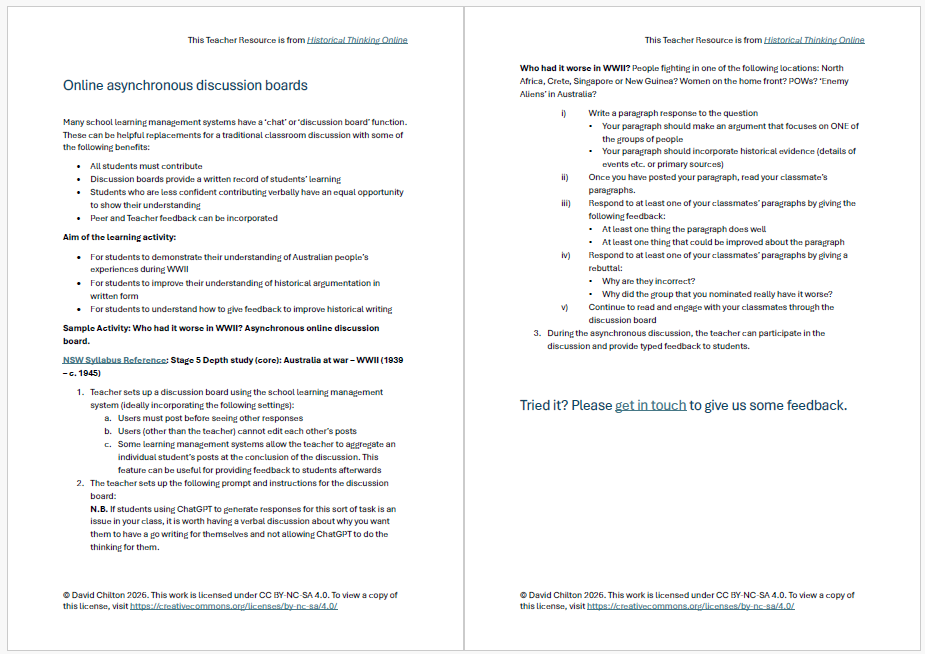
Online asynchronous discussion boards
Many school learning management systems have a ‘chat’ or ‘discussion board’ function. These can be helpful replacements for a traditional classroom discussion with some of the following benefits:
All students must contribute
Discussion boards provide a written record of students’ learning
Students who are less confident contributing verbally have an equal opportunity to show their understanding
Peer and Teacher feedback can be incorporated
Aim of the learning activity:
For students to demonstrate their understanding of Australian people’s experiences during WWII
For students to improve their understanding of historical argumentation in written form
For students to understand how to give feedback to improve historical writing
Sample Activity: Who had it worse in WWII? Asynchronous online discussion board.
NSW Syllabus Reference: Stage 5 Depth study (core): Australia at war – WWII (1939 – c. 1945)
DOWNLOAD TEACHER RESOURCES
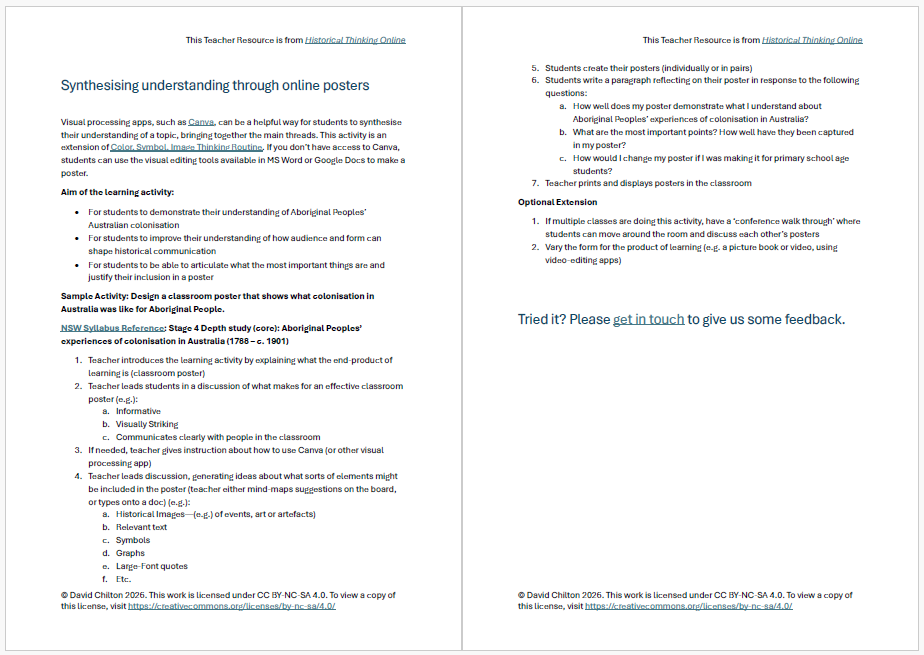
Synthesising understanding through online posters
Visual processing apps, such as Canva, can be a helpful way for students to synthesise their understanding of a topic, bringing together the main threads. This activity is an extension of Color, Symbol, Image Thinking Routine. If you don’t have access to Canva, students can use the visual editing tools available in MS Word or Google Docs to make a poster.
Aim of the learning activity:
For students to demonstrate their understanding of Aboriginal Peoples’ Australian colonisation
For students to improve their understanding of how audience and form can shape historical communication
For students to be able to articulate what the most important things are and justify their inclusion in a poster
Sample Activity: Design a classroom poster that shows what colonisation in Australia was like for Aboriginal People.
NSW Syllabus Reference: Stage 4 Depth study (core): Aboriginal Peoples’ experiences of colonisation in Australia (1788 – c. 1901)
DOWNLOAD TEACHER RESOURCES